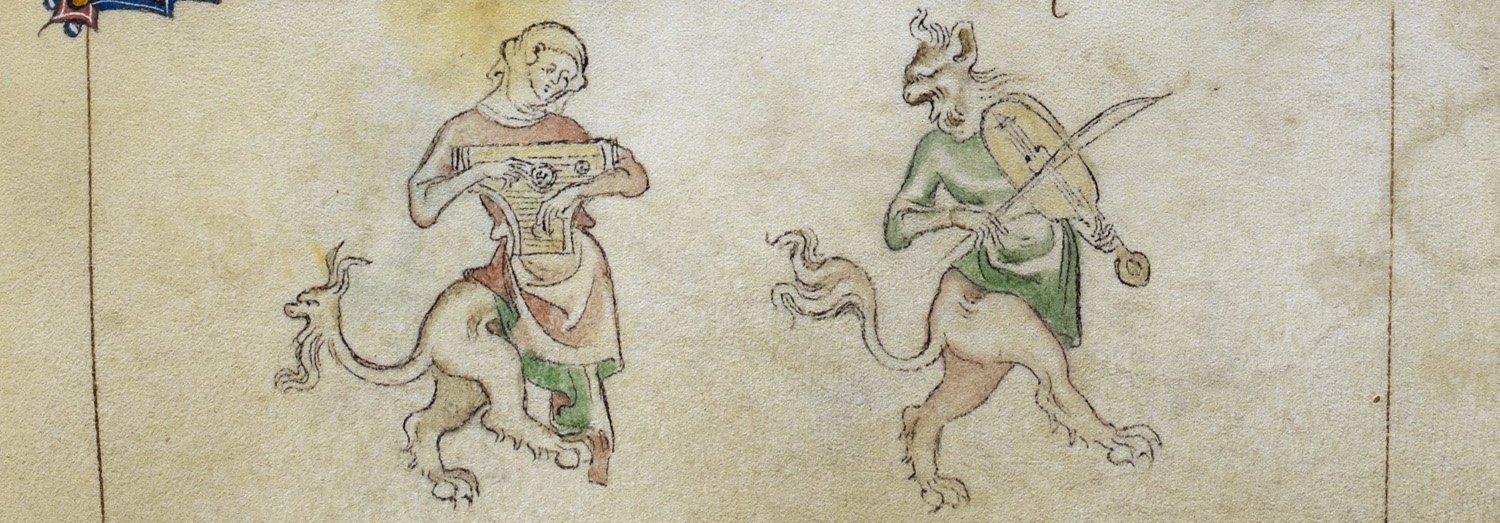
 Edi beo þu heuene quene is a 13th century song in praise of the Virgin Mary, written in Middle English. It expresses loving familiarity with Mary, using the language of romantic attachment; and the two part vocal harmony sounds remarkably modern. This article explores why this is so, placing this beautiful song in its three contexts – poetic, musical and historical – followed by a reflection on singing medieval religious songs in a modern secular context.
This is a revised and expanded version of an article first published in January 2018, with new material and a new video performance of Edi, both polyphonic vocal lines sung, introduced by an instrumental verse on gittern and citole.

The two voice parts of Edi beo þu heuene quene, sung in modern English, with subtitles
showing the original Middle English. The melody is introduced on gittern and citole.
(Best heard on headphones.)
The poetic context: troubadour fin’amor and religious love

MS 59, with the music and words of Edi beo thu,
followed by the beginning of Orbis honor, celi scema.
Used with the permission of the President and Fellows
of Corpus Christi College, Oxford, to whom thanks.
(As with all pictures, click to see larger in a new
window, click in new window to further enlarge.)
Edi beo þu heuene quene (hereafter rendered in modern characters as Edi beo thu hevene quene) survives in a single source, a manuscript associated with Llanthony Secunda Priory in Gloucestershire, now classified as Corpus Christi College, Oxford, MS 59 (CCC MS 59), dated between 1265 and the late 13th century. It includes three pieces of music, all religious songs:
• Recitemus per hec festa (Let us recite through these feasts) in Latin, celebrating the healing miracles of Saint Kyneburga (folios 68r–69r);
• Edi beo thu hevene quene (Blessed are you, queen of heaven) in Middle English, in praise of the Virgin Mary (folio 113v);
• Orbis honor, celi scema (Honour of the world, figure of heaven) in Latin, also in praise of the Virgin Mary (folios 113v–114r).
The rest of the manuscript is largely taken up with Anticlaudianus, a work of moral theology by French theologian and poet, Alain de Lille, written c. 1182, and a gloss of the very popular De consolatione philosophiae (The consolation of philosophy) by 6th century Roman senator and philosopher, Boethius.
Edi beo thu has 8 stanzas, divided stylistically into the first 5 and the last 3.
In the first 5 stanzas, the anonymous writer used the metrical form and many phrases from Latin hymns, translated into Middle English. The first-person narrator of the song praises Mary in standard religious ways: she is blessed, a comfort, unblemished, pure, etc. Interspersed with these common Christian sentiments, many phrases in the song are in the unmistakeable language of the troubadours, the poets of Occitania, whose influence on secular song internationally cannot be overstated, and whose influence on worship of Mary was mainstream Catholicism by the 13th century: the church co-opted troubadour expressions of the sensual desire of a man for a woman to tame them and bring them within the ambit of desire for the divine. In Edi, Mary is praised in just the same way troubadours praised the love object of fin’amor, meaning refined love, the chief genre of troubadour poetry. In fin’amor, the longed for woman is always of a higher social status than the male narrator and she is physically beautiful. Though she is unattainable, the protagonist swears his undying desire, love and loyalty. In the same way, in Edi, the Virgin Mary is a queen who is praised for her complexion, for her fair beauty, for her nobility, her virtue, her education, and the love bond with her is expressed as the bond of allegience between a knight and a high-born lady. (For more on the profound influence of troubadour poetry on worship of Mary, click the blue text to go to “Why do you not praise her?”: the Virgin Mary and the troubadours.)
Spelling indicates that the first 5 stanzas are a south-west Midlands scribal copy of a poem composed in the south-east Midlands. There follows my translation from Middle English to modern English, retaining the original metre, as sung in the video.
Blessed are you, queen of heaven, people’s comfort and angels’ bliss;
Mother unblemished and maiden pure, such in this world none other is.
It is clear for all to see that of all women most noble you are:
My sweetest lady, if you will, have pity on me and hear my prayer.
You arose as the break of day that separates out from the dark of the night;
From you sprang new illumination, bathing the whole of the world in light.
There is no maid of your complexion, so fair, so beauteous, so rosy, so bright.
Sweet lady, on me have compassion and have mercy on me, your knight.
Blossom sprung from a single root, the Holy Ghost does you rest upon,
For the salvation of all mankind, all souls to redeem in exchange for one.
Gentle lady, soft and sweet, I cry for mercy, I am your man,
Both hand and foot [and all completely], serving you in all ways that I can.
You are earth to good seed, on you fell the heavenly dew;
From you sprang the blessed fruit the Holy Ghost had sown in you.
You bring us out of care, of dread, that Eve so bitterly for us brewed:
You shall us into heaven lead, so very sweet is that heavenly dew.
Mother, full of noble virtue, maiden patient, well-taught and wise,
I am in your love now bonded, and for you is all my desire.
You shield me from the fiend of hell, as you are noble, with will and might:
Help me till my life is ended, and with your son me reconcile.
The video which begins this article (also accessible by clicking here) is sung in modern English with the original Middle English subtitled. Since there are implicit meanings in some Middle English phrases not present in modern English, there are some explanatory expansions in the modern verse. In the third stanza, final line, the original Middle English states “Bothe to honde and to fote” – “Both hand and foot”. My added words in square brackets, “[and all completely]”, give the full meaning of the phrase for a modern listener, being complete and dedicated service to a person. The fifth stanza, end of the first line, describes Mary as “wel itaucht”. I render it as “well taught and wise” to indicate that “well taught” refers as much to the wisdom of the person taught as to the teachers. In addition, the “wel” of “wel itaucht” refers to the goodness and holiness of a person who acts in accordance with God’s law or will.
Why modernise the words at all? As I argue in this article (under the subheading, Language), songs are about communication, and meaning can only be communicated in a language the listener understands. Medieval singers knew this, which is why they translated Latin and French songs into Middle English. I therefore follow medieval practice, doing for my audience what they did for theirs.
The final 3 stanzas are entirely doctrinal, in the manner of the Latin song that follows in the manuscript, Orbis honor, celi scema (Honour of the world, figure of heaven). The highly personal tone and the striking imagery taken from troubadour poetic conventions disappears, leaving only impersonal theology, such as: “You have a great lineage from David the powerful king … Marvellously, the Lord arranged that you were a maid without husband … Bring us to your abode and shield us from hell’s wrath.” Furthermore, the rhyme scheme of stanzas 7 and 8 is different to the previous 6. On stylistic grounds, it is therefore clear that the final 3 verses are a later addition to the original composition, and this in turn means there must have been an earlier manuscript version of the song, now lost.
The musical context: the modes and the gymel

The Assumption of The Virgin, for example, painted 1448–52 by Italian
artist, Sano di Pietro, has Mary accompanied by angels playing psaltery,
vielle (fiddle), lute and shawms. (As with all pictures, click to see larger in a new window.)
In the medieval period, ecclesiastical music was modal or tonal. Each of the 8 modes or tones had a natural scale and a final resolving note, called the finalis, and a tenor, being a reciting or dominant note with a prominent place in the melody. The dorian mode, for example, had a finalis of D and a tenor of A, the phrygian mode a finalis of E and tenor of C, the mixolydian mode a finalis of G and a tenor of D, all without accidentals. The one exception to having only natural notes in the medieval gamut, the theoretical range of notes, was the inclusion of Bb, a note that was not integral to any mode, but was a condiment used in particular musical circumstances.
Secular music was less strict about modal rules or it did not conform to them at all. Edi begins and resolves on F, with a fixed Bb, and it therefore fits none of these ecclesiastical modes.

with unisons, but otherwise focussed on harmonising in thirds.
In 1547, Swiss music theorist Heinrich Glarean (or Glareanus) extended the 8 modes to 12. In his Dodecachordon, published in Basle, one of the 4 modes he added was ionian, with a finalis of C and a tenor of G. Edi is in the ionian mode, transposed up a fourth, with a starting note and finalis of F and a fixed Bb. Since ionian was not one of the ecclesiastical modes of the 13th century, this suggests that, though the subject is religious, Edi beo thu was not liturgical or ecclesiastical, not intended to be sung in church.
The harmony of medieval music was polyphonic, meaning many voices. This worked very differently to modern music’s use of major and minor scales and largely major and minor chords to create harmonies underpinning a melody. Polyphonic music started and ended with a consonant or stable interval between parts, being a unison, an octave, or a fifth. Within a phrase, intervals between voices could be dissonant or unstable, seconds and sevenths, working their way back, usually step-wise, to perfect consonance by the last note of a resolving cadence. Thirds and sixths were considered an imperfect consonance, more stable than dissonant seconds and sevenths, but not stable enough for resolution.

of MS C 233, University Library, Uppsala, Sweden.
(As with all pictures, click the picture to see
it larger in a new window, then click in the
new window to further enlarge.)
The polyphony of Edi is not typical of medieval music. This is a gymel, from the Latin, cantus gemellus, twin song, sung in two parts, in which the usual fixtures of medieval polyphony are largely laid aside in favour of accompanying almost entirely in thirds and/or sixths, often moving in parallel. This definition of a gymel as marked by thirds and sixths is from the 15th century music theorist Guilielmus Monachus (about whom nothing is known, not even his nationality – English or Italian?), though the practice is evident in England from the beginning of the 13th century. All surviving gymels are either English or Scottish.
Another religious example of a gymel, contemporaneous with Edi, is the Latin Nobilis humilis in a manuscript of De Miseria Condicionis Humane (The Misery of the Human Condition), also known as Liber de Contemptu Mundi (Book of Contempt for the World) by Cardinal Lotario dei Conti di Segni, who was later Pope Innocent III. Nobilis humilis (folios 19v–20r, shown on the right, the first stanza in modern notation below) and a royal wedding song, Carmen gratulatorium (folios 50v–51r), were added to blank pages of the manuscript, written out by the monks of Saint Magnus Cathedral, Kirkwall, Orkney, in c. 1280 (now MS C 233 in University Library, Uppsala, Sweden). The melodic movement will sound unfamiliar to modern ears, since it is in the lydian mode, resolving on F. The polyphony, however, is very modern-sounding, avoiding the crunchy dissonance so typical of movement in medieval polyphony, relying instead on the continual sweetness of parallel thirds.

A contemporaneous example of a secular Middle English gymel is the one verse fragment, Foweles in þe frith, c. 1270 (about which there is an article with a performance video here). As we see below, the voices are based largely on contrary motion while always reaching for the interval of a third or a sixth between parts, the essential characteristic of a gymel.

To hear Foweles in þe frith, click here.
The use of harmonic thirds is the reason the gymel harmony of Edi sounds so modern. Other than in the gymel, we don’t hear such use of thirds and sixths until the musical revolution of John Dunstaple in the 15th century, which ushered in the renaissance sound, the “English countenance”, a term used in admiration by the French poet, Martin le Franc, in his Le Champion des Dames, 1440–42. The third, the sixth, and full triadic chords of root, third and fifth were the harmonic intervals often used by John Dunstaple which, together with his throwing 4 voices wide apart in pitch for the first time, ushered in the early modern period in music, the beginning of the now familiar SATB (soprano, alto, tenor, bass).
The historical context: Marian devotion in medieval England

with the holy house in her left hand,
a rosary in her right hand, at the shrine
in Walsingham, England.
Edi beo thu takes us back to a time when England had its own site of Marian pilgrimage in Walsingham, established by Rychold or Richeldis de Faverches, a devout English noblewoman. Her encounter with heavenly visions is told in a ballad printed by Richard Pynson between 1496 and 1499, therefore often referred to as The Pynson Ballad (now in book 1254, Pepys Library, Magdalene College, Cambridge). The stanzas tell the story of events in 1061. Richeldis de Faverches, widow and Lady of the Manor, had 3 visions or dreams in which the Virgin Mary showed her the house in Nazareth where the annunciation took place. (The annunciation was the visit of the angel Gabriel to declare to Mary that she was to conceive and give birth to Jesus while remaining a virgin.) The exact dimensions of the house were dictated to Richeldis in her dreams, and she was instructed to build it in the village of Walsingham. Richeldis immediately set her builders and carpenters to work on the special task but, after the first day of work, they returned looking pessimistic. That night, unable to sleep, she heard singing coming from the barely started structure. She ran outside to look and was amazed to see angels departing and that the building had moved 200 feet or more. In the morning the builders agreed that the house had been completed properly, beyond their capabilities, and that it stood solid on its new foundations.
Richeldis’ son, Geoffrey, became Lord of the Manor and Earl of the Marches. On Richeldis’ death, Geoffrey took responsibility for Mary’s holy house and it thrived as a centre of pilgrimage. Walsingham became known as Little Nazareth: pilgrims unable to make devotional journeys abroad could now go to their own holy land in Norfolk.
In the middle of the 12th century, Augustinian Canons (a canon is a member of a ruling ecclesiastical body) established The Augustinian Priory to the Annunciation of the Blessed Virgin Mary next to the Virgin Mary’s house. By the 13th century, when Edi was written, Walsingham’s importance as a pilgrimage site was comparable in England to Rome, Jerusalem and Santiago de Compostela. With rapidly increasing numbers of pilgrims, the village grew to cater for them. By 1252, a charter had been granted to hold a weekly market and an annual fair. Such was its growth and importance that pilgrims travelled from all over Europe, including the monarchs of England. Before the surviving version of Edi was written down, Henry III had visited the Walsingham house in 1241; at about the time it was written, Edward I visited in 1280 and 1296. By the 14th century, pilgrims were visiting in such numbers that the priory was extended and the small wooden holy house had a stone chapel built around it to encase and protect it. After Edi was penned, the royal pilgrims were Edward II in 1315; Henry VI in 1455; Henry VII in 1487; and Henry VIII in 1513, before his conflict with the Catholic Church.
Climbing inside a song: modern performance of medieval religious music in secular contexts
Such are the poetic, musical and historical contexts of Edi beo thu. Finally, we turn to the question of performing medieval devotional songs in a modern secular context.
I am an atheist, but a huge proportion of surviving medieval song is religious, so a decision has to be made about repertoire: to include or avoid the devotional. The fit of singer and song is a complex and enigmatic affair. For a song to have life and meaning, a singer must connect personally with the song’s broad theme or with some aspect of the poetry. In this way, a singer is in a similar position to an actor, who must find a motivation for the character s/he is to perform, develop a personal association with the part, and thereby play convincingly to an audience. As with an actor playing a part, the experience in the song is not that of the singer, but the performer can empathise with the song by putting him/herself in the protagonist’s place.
Having connected with a song, one then rehearses and performs it, hoping the audience finds a connection, too. In performance, there can be something about playing religious songs for a non-religious audience that is different to any other theme. My most powerful and peculiar confirmation of this was when performing the beautiful traditional song, Down In Yon Forest, in a folk club. The song is a variant of the carol called Corpus Christi, first attested in the handwritten commonplace book of Richard Hill of London, dated to between 1503 and 1536 (Balliol College, Oxford, MS 354), and it was still being sung in different versions to folk song collectors from the mid 18th to the early 19th century. In the variant I sang, collected from Mr. Hall of Castleton by Ralph Vaughan Williams and Ivor Gatty in 1908, its arresting and mysterious imagery included the bells of paradise; a hall covered in purple coffin cloth; a bed covered with red (cloth, presumably); the Virgin Mary kneeling on a stone; a flood of water and blood underneath a bed; and a thorn bush that blossomed white on the day a knight was born.

Popeluc (Pete Castle, Ioan Pop, Lucy Castle) perform Down In Yon Forest (traditional).
The whole room of people had joined in loudly and lustily on choruses about halyards they had never pulled on ships they had never seen, bellowed about battles they had never fought in, and sung tenderly for the love of women they had never met. This is standard fare in a folk club, and very enjoyable it is, too. Yet their joining in with the Down In Yon Forest refrain, “And I love my Lord Jesus above any thing”, was a collective whimper of embarrassment. For them, the sung declaration of love for Jesus felt qualitatively different to being the imaginary crew on board ship, or fighting fantasy wars, or loving make-believe women. It is only with religion, it seems, that the problem arises for a singing audience.
This illustrates that for a song to be effective, it not only has to connect with the singer who performs it, but also with the audience who hear it and, when the song is participatory, with the singers who join in the refrain. Why did my folk club audience baulk at joining in with Down In Yon Forest? Perhaps it is because, in these modern times, many find religious expression fraught with problems. We debate the logical veracity of miracles and religious faith; wonder about the morality of needing a figure like Jesus to save us from a God who would otherwise torment us in everlasting hell; we pose questions about a heavenly role model for women who is impossibly both a mother and a virgin, and whose chief virtue in the Gospels is meekness and obedience.

(Musée des Augustins, Toulouse, France).
All such critical analysis is important, of course, but if that is all we do I fear we are missing the art of song, which is to transport the singer and the audience so that for 3 or 4 minutes we appreciate and empathise with the experience of another person. To perform or join in with a historical Christian song, we no more have to believe in God or the Virgin Mary than we have to be a sailor to sing a shanty, be a soldier to sing about a battle, or be a felon to sing a murder ballad.
If, as singers, we are to understand historical songs, to get inside the heads and under the skin of the people of the past, we first have to comprehend their collective conceptual framework and its influence upon an individual. In the case of Edi beo thu, the fact that its musical mode was not one used by the church indicates that it was non-liturgical. In the middle ages, people could not turn off their religious sentiment at the church door, as for them it was a worldview, a universe of meaning. The complete division between the secular and the sacred is a modern idea, only possible in a context where atheism is thinkable and religion is a matter of personal belief rather than a societal norm. So for singers of early music who wish to climb inside a song and understand it from the inside, this will often include an imaginative leap to understand loving “my Lord Jesus above any thing” and the motivation for composing a love song for the “queen of heaven” who is “of all women most noble”.
Can an atheist have a personal connection to a religious song such as Down In Yon Forest and Edi beo thu hevene quene to motivate its performance? Most certainly – up to a point. I am often struck by the inventiveness and beauty of Christian Middle English poetry. In the case of Edi, I can appreciate the beauty of its verse and the charm of its melody, its gymel polyphony. But I am necessarily unable to fully appreciate the devotional sentiments which inspired the anonymous writer to compose it. And, as a modern person living in a largely secular society, I cannot mentally recapture a Europe in which being Catholic was normative and there were many thriving centres of Marian pilgrimage. Perhaps this is similar to the line my folk club audience couldn’t cross, wordlessly saying, ‘In song, I can imagine working on board ship, I can imagine fighting a battle, I can imagine loving a woman, but I just can’t imagine loving Jesus’.
I can’t imagine loving Jesus, either, nor the Virgin Mary, at least not in the specific and literal sense. But, like the actor who finds a personal point of contact with his role, I can certainly imagine loving. Behind its startling imagery, Down In Yon Forest is a Christian love song to Jesus. We may call Edi beo thu a devotional song, a religious song, a Christian song: however we categorise it, it is surely a love song by any name. My point of access to both songs is the beauty of the language which could stand for praise of any true love. Indeed, for Edi beo thu, this was the intention of its most affecting phrases in its original troubadour context:
“It is clear for all to see, that of all women most noble you are … There is no maid of your complexion, so fair, so beauteous, so rosy, so bright. Sweet lady, on me have compassion and have mercy on me, your knight … Gentle lady, soft and sweet, I cry for mercy, I am your man; both hand and foot [and all completely], serving you in all ways that I can … I am in your love now bonded, and for you is all my desire.”
© Ian Pittaway. Not to be reproduced in any form without permission. All rights reserved.
Bibliography
Antonsson, Haki & Ommundsen, Åslaug (2014) Sanctus Magnus dux. Available online here.
Catholic National Shrine of Our Lady (2024) History of the Catholic National Shrine. Available online here.
Deeming, Helen (2013) Songs in British Sources c. 1150–1300. London: Stainer and Bell.
Dickinson, J. C. (1956) The Shrine of our Lady of Walsingham. Appendices. Available online here.
Dobson, E. J. & Harrison, F. Ll. (1979) Medieval English Songs. London: Faber and Faber.
Ferrie, Becky (undated) Walsingham Priory & Slipper Chapel, Eastern England. Available online here.
Gilchrist, Annie G. (1910) Over Yonder’s a Park. Journal of the Folk-Song Society, Vol. 4, No. 14 (June 1910), pp. 52–66. Available online here.
Page, William (1906) Houses of Austin canons: The priory of Walsingham. In: A History of the County of Norfolk: Volume 2. London: Victoria County History. Available online here.
Pittaway, Ian (2017) “Why do you not praise her?”: the Virgin Mary and the troubadours (Cantigas de Santa Maria article 1/6). Available online here.
Pittaway, Ian (2018) Performing medieval music. Part 2/3: Turning monophony into polyphony. Available online here.
Pittaway, Ian (2019) Foweles in þe frith (birds in the wood): mystery and beauty in a 13th century song. Available online here.
Regents of the University of Michigan (2026) Middle English Compendium. Available online here.
Sacred Destinations (2005) Shrine of Our Lady of Walsingham. Available online here.