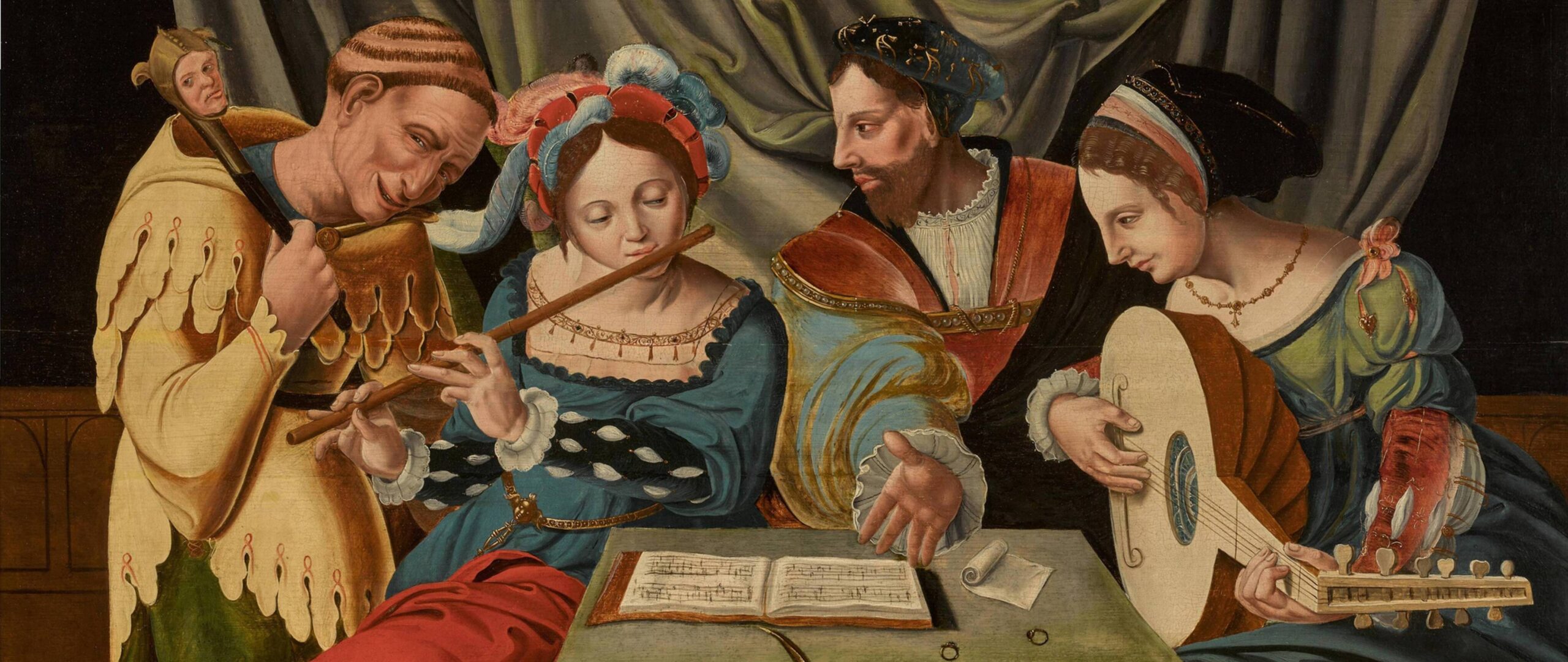
There were three Ravens: sublime love and ridiculous riddles

The earliest surviving record of There were three Ravens is in Melismata, a book of songs compiled by Thomas Ravenscroft, published in 1611. Since Ravenscroft did not write this anonymous song, this article describes his role in bringing it to print.

The story told in the song is that a knight lay dead in a field; three ravens were prevented from predating on his body by his faithful hounds and hawks guarding him; his pregnant lover found his body, carried him and buried him; then she died from the strain. Within this simple tale is a centuries-old tradition of profound symbolism and meaning, which is explored.

There were three Ravens includes some nonsense syllables – “downe a downe hey downe hey downe” – so the next section puts this in the context of rhythmic vocalising in renaissance and traditional music.

In the modern era, Ravens has been interpreted in ways that are so bizarre and incongruous they are genuinely hilarious. The logical pitfalls and absurdities are explained.

In the oral tradition, variants of Ravens were collected in the intervening centuries in England, Scotland, the USA and Canada. A second article, Three Ravens and Twa Corbies: the transformations of a traditional song from the 17th to the 20th century, explores this song tradition.  

We begin with a video performance of There were three Ravens as published by Thomas Ravenscroft in 1611, performed with 4 voices and 4 lutes.

Read more

Tarleton’s Resurrection. Part 3/4: Richard Tarleton the musician and broadside writer

Elizabethan actor and comedian Richard Tarleton is remembered most for his quick-witted and clever quips, his physical comedy, and for the image of him playing pipe and tabor. Despite the fact that this famous representation shows him as a musician, Tarleton the musician has remained a neglected subject in both historical and modern accounts.

This article aims to put that right, with a description of Tarleton’s taboring; an investigation into the meaning of the surviving tune that bears his name, called both Tarletons jigg and Tarletons Willy; an understanding of his theatrical role as the creator of extempore comedy songs; and a survey of the evidence for Tarleton as a composer of ballads, particularly the comedic genre known as the medley.

This is the third of four articles about the life and music of Elizabethan clown, Richard Tarleton. The final article will examine posthumous tributes, including the performance of a 16th century ballad about him, its words and music newly reunited after 400 years. 

Read more

Tarleton’s Resurrection. Part 1/4: Tarleton’s place in the history of fools, clowns and jesters

Richard Tarleton – fool, actor, playwright, poet, musician and legend – was the foremost stage clown of his age, celebrated in his own lifetime and well beyond. As an actor, he was a star of the stage when permanent theatre buildings were new, a fool or comedian of great physical and verbal wit, a serious player of affecting pathos, and a member of Queen Elizabeth I’s own acting company, The Queen’s Players. As a successful playwright, he wrote in the tradition of morality plays. As a poet and essayist, he wrote on the theme of natural disasters and divine displeasure. As a musician, he was a player of pipe and tabor and a creator of extempore comedy songs. As a legend, much-loved and much-missed after his sudden death, he was a byword for exemplary wit, his name used to sell literature for decades, his image still used and recognised two centuries later.   

This is the first of four articles trawling 16th and 17th century sources to build up a picture of the man. This introductory article begins with a short history of fools in their three types – natural, ungodly, and artificial – to put Tarleton in his historical context; clarifies what contemporaneous writers meant when they described him as a jester; then describes his ‘country fool’ clown’s costume and notable physical appearance. Two neglected topics comprise the second and third articles. Part 2: Tarleton the player and playwright considers his range as a comic and serious actor and his style as a playwight, with an evidenced reconstruction of his lost play, The Secound parte of the Seven Deadlie Sinns. Part 3: Richard Tarleton the musician and broadside writer examines his style as a taborer; describes Tarleton as a comedic creator of extempore songs from themes called out by the audience; and surveys the evidence for Tarleton as a composer of ballads. Part 4: Tributes to Tarleton – with a musical discovery from the 16th century summarises the broadside ballads, books and plays which praised Tarleton and used his persona after his premature death. In particular, a musical biography of Richard Tarleton, A pretie new ballad, intituled willie and peggie, has its words and music reunited after 400 years of separation in a featured video performance.

Read more

The scandalous la volta: “such a lewd and unchaste dance”

La volta (or volte or volt or, in England, lavolta) was reputedly the favourite dance of Queen Elizabeth I, performed by couples with much leaping, lifting and turning. The dance, a variation of the galliard, was considered scandalous by the moralists of the day. Just as today we hear talk of ‘gateway drugs’ leading to harder and more destructive substances, la volta was considered a ‘gateway dance’, leading to more destructive vices. This article describes the key point of the choreography, discusses the moral opprobium it attracted, and weighs up the evidence for the Queen dancing this “lewd and unchaste dance”.

We begin with a performance of two voltas by The Night Watch.

Read more

Wired for sound: the bandora and orpharion

In the early music revival, many renaissance and baroque instruments have received their due recognition: the lute in its various forms, the viol family, early violins, recorders, guitars and keyboards, for example. Less familiar and less played are two related instruments, the bandora and orpharion. Both were strung with wire and plucked, they shared the same scalloped shape and fanned frets, and both were particularly popular in England. The deep pitch of the larger bandora made it eminently suitable as the plucked bass of the mixed consort, while the orpharion shared the tuning and repertoire of the renaissance lute and was considered an interchangeable alternative.

This article gives a brief history of both instruments, with indications of their respective repertoires, the descriptive testimonies of contemporaneous writers, some lost related instruments, and videos of both the bandora and orpharion being played.

Read more

Music of the renaissance: a whistle-stop tour

RenaissancePeriodThe renaissance marked a turning point for European culture. Beginning in Italy in the 14th century, its influence spread across Europe, affecting all aspects of culture, including music. But it was in England that the sound of the renaissance first developed, spreading out to Burgundy, Italy, and then back to England in new forms. The invention of the printing press and the spread of literacy profoundly affected music-making, with musicians in households now able to write down music, use the new printed songbooks of composers such as John Dowland, and sing from broadside ballad sheets sold in the street. The spread of printing and literacy also affects our own knowledge of the period, with surviving instructions for dances and a wealth of music. Includes 15 active links in blue to videos of musical examples, illustrating the text.

Read more

The lute: a brief history from the 13th to the 18th century

Lorenzo Costa, A Concert, c. 1485-95.

The lute’s musical versatility, giving one musician the ability to play several polyphonic parts over a wide and increasing pitch range, made it once the most popular instrument in Europe, the ‘prince’ of all instruments. From the Arabian oud to the medieval, renaissance and baroque lutes, this article briefly charts the development of this versatile, beautiful and enduring instrument, featuring 8 videos illustrating the changes and developments of the lute and its music.

Read more

Greensleeves: Mythology, History and Music. Part 1 of 3: Mythology

The remarkable longevity of a 16th century song and tune

101_JanePALMERGreensleeves, composed anonymously in 1580, is a song which has been a magnet for fanciful claims. This article examines the claims that Henry VIII wrote it for Anne Boleyn; that Lady Greensleeves was a loose woman or a prostitute; and that the song has Irish origins. This is the first of three articles, looking at the song’s mythology; its true history; and video examples of its musical transformations.

Read more