 The trees they do grow high is a traditional ballad about an arranged child marriage, also known as The trees they grow so high, My bonny lad is young but he’s growing, Long a-Growing, Daily Growing, Still Growing, The Bonny Boy, The Young Laird of Craigstoun, and Lady Mary Ann. The song was very popular in the oral tradition in Scotland, England, Ireland, and the USA from the 18th to the 20th century. Questions about its true age (medieval?), the basis of its story (describing an actual marriage?) and its original author (Robert Burns?) have attracted conjectural claims. This article investigates the shifting narrative of the story over its lifetime and sifts the repeated assertions from the substantiated evidence.
The Lyke-Wake Dirge: the revival of an Elizabethan song of the afterlife
 The Lyke-Wake Dirge, with its dark, mysterious imagery and its brooding melody, is known to singers of traditional songs through its resurrection in the repertoire of folk trio The Young Tradition in the 1960s, and its subsequent recording by The Pentangle and others. What many of its performers may not realise is that its history can be reliably traced to Elizabethan Yorkshire, with a hint from Geoffrey Chaucer that its origins may be earlier. This article uses direct testimony from the 16th and 17th century to explore its meaning, its perilous and punishing “Whinny-moor”, “Brig o’ Dread”, and “Purgatory fire”; and discovers the surprising origin of its doleful dorian melody.
Read more
On the medieval fiddle: a short introduction to the vielle
 A mention of the violin today is likely to conjure up images of a classical, orchestral, or jazz musician, whereas the word fiddle is more likely to suggest a traditional or folk musician, even though they’re essentially the same instrument, set up differently to suit different styles of playing. This class-based relegation of the term fiddle was not always so. Centuries before the creation of the violin there was the medieval fiddle, also known by its French name, the vielle. This brief introduction demonstrates that the playing style and sound of the medieval fiddle had more in common with the hurdy gurdy and the crwth (bowed lyre) than the modern violin. Includes illustrations and video examples.
This is one of two editions of this article, being a short introduction to the vielle, intended for the general reader. There is a longer version, The mysteries of the medieval fiddle: lifting the veil on the vielle, which has a detailed discussion of the different ways in which we can make sense of historical fiddle tunings and, in the light of that, a closely argued case for the relationship between the vielle and the crwth.
The mysteries of the medieval fiddle: lifting the veil on the vielle
 The vielle or medieval fiddle was the most popular instrument in its heyday for secular song accompaniment. It first appeared in western Europe in the 11th century and continued to be played until the middle of the 16th century, flourishing in the 12th and 13th centuries. There is a wealth of vielle iconography, which can tell us a great deal about the variety of its form and the context of its use. There is a medieval source for its tuning, Jerome of Moravia in the 13th century, who gives 3 tunings for 5 strings, leaving us with some puzzles as to what exactly they mean in practice, and whether they can be applied to fiddles with fewer than 5 strings. Our only renaissance tuning source is Johannes Tinctoris in the 15th century, which isn’t entirely clear in its meaning.
This page provides a detailed discussion of the different ways in which we can make sense of historical fiddle tunings and, in the light of that, a closely argued case for the relationship between the vielle and the crwth or bowed lyre, demonstrating that they were identical in style, having more in common with the hurdy gurdy family than modern bowed strings.
There are two editions of this article. This one includes detailed analysis. For a brief introduction, go to On the medieval fiddle: a short introduction to the vielle.
The rebec: a short history from court to street
 The rebec is a late medieval and renaissance gut-strung bowed instrument with 3 strings, its body carved from a solid piece of wood. Its sound has a nasal quality, unlike the more full-sounding modern violin, which shares some of the rebec’s characteristics: strings played with a bow, a fretless neck, a curved bridge to allow strings to be bowed singly, and a soundboard carved to have a gentle upward curve. Distinguishing the rebec from other medieval and renaissance bowed instruments, in particular the vielle (medieval fiddle), has been a matter of some contention until more recent scholarship re-evaluated the primary evidence.
Though the rebec has gained a reputation as a medieval instrument, it was still being played beyond the renaissance and to the end of the baroque period in western Europe, by now having fallen from grace from a regal courtly instrument to one of lowly street entertainment.
This article begins with a video of Igor Pomykalo playing an Italian Saltarello, c. 1400, on rebec.
The beautiful Boissart mandore, part 3 of 3: Creating a new mandore inspired by the ‘Boissart’ design
 It is difficult to describe the joy of a private viewing of the beautiful and tiny mandore in the Victoria & Albert Museum. The instrument, repaired in 1640 by the mysterious Monsieur Boissart and made c. 1580–90, is exquisite. You can view photographs and read my observations about it in the second of these three articles. The first article traces the history of the mandore, with its origins in the lute and gittern familes. This, the third and final article, is a record of the design and making of a new mandore based on, but not a replica of, the V&A’s instrument. The affable and ever-accommodating maker was Paul Baker; the delighted and very lucky player is Ian Pittaway, the author of this piece. This was to be a new journey for us both: me never having played a mandore, Paul never having made one. The article includes a video of the completed mandore playing 3 pieces from the John Skene mandore book of 1625-1635, accompanied by photographs of its construction.
The Psilvery Psound of the Psaltery: a brief history

of Beverley Minster, 1330–90.
Photograph © Ian Pittaway.
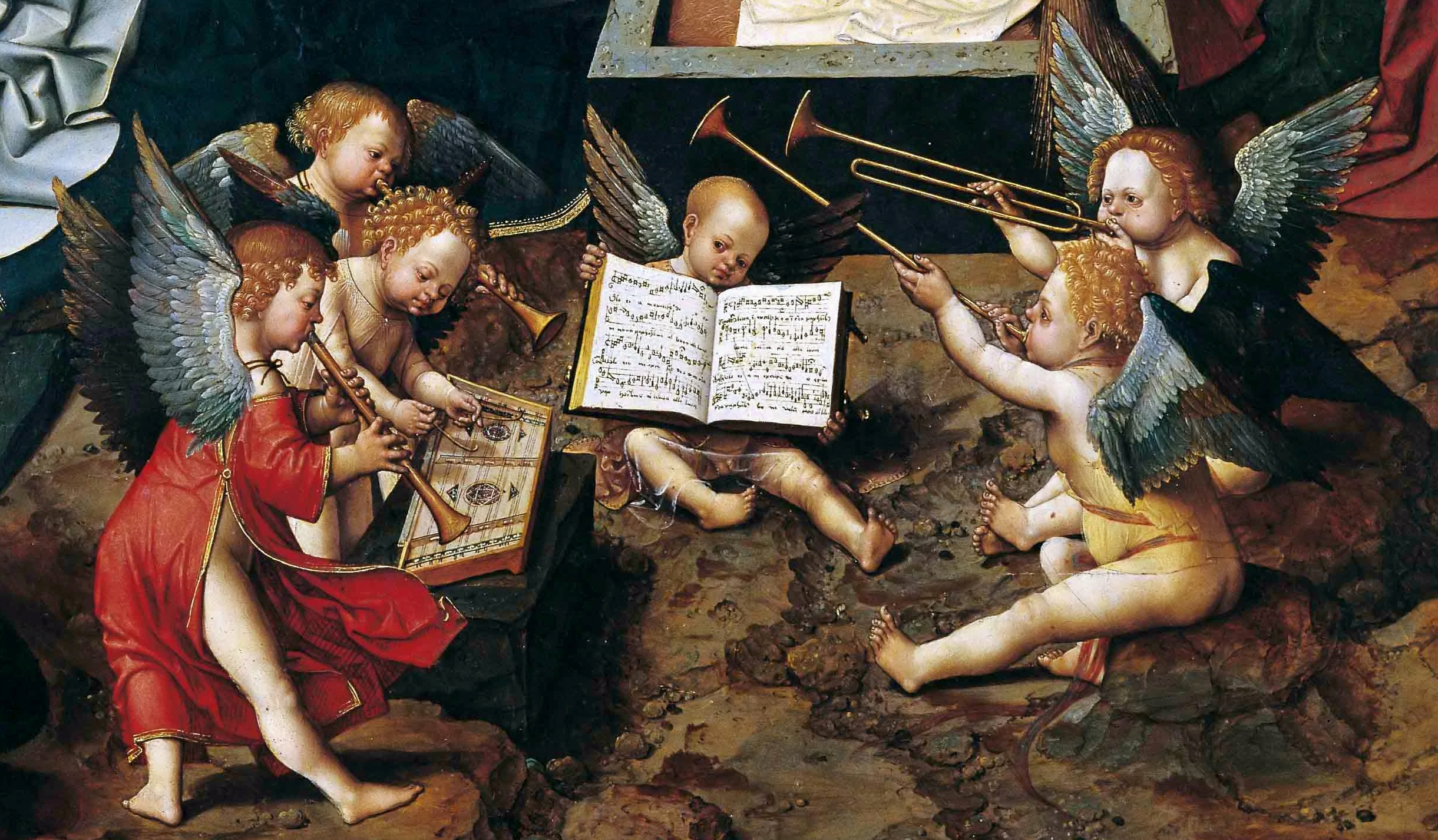
There is something quite enchanting about the silvery sound of the psaltery. Its name probably originates in religious use, as an accompaniment to singing songs from the psalms, known as psalmody and sung from a psalter, thus the psaltery. The word is from the Old English psealm or salm and Old French psaume or saume, derived from Church Latin psalmus, which itself comes ultimately from the Greek psalmos, a song sung to a harp, and psallein, to pluck on a stringed instrument.
From the 11th century, the psaltery’s wire strings rang out in Europe in religious and secular contexts until around 1500, with little pockets of survival in the 16th century. Its regular appearance in manuscript art, church iconography and in Geoffrey Chaucer’s Canterbury Tales are evidence of its wide use and appeal.
The influence of the psaltery on later musical developments is surprisingly widespread, giving rise to the hammer dulcimer, the harpsichord family, and ultimately the piano.
Bird on a briar: interpreting medieval notation, with a HIP harp arrangement
 The aim of this article is to arrive at a performable and historically justifiable arrangement of the problematic song, bryd one brere, c. 1290–1320. This is the oldest surviving secular love song in the English language with a complete lyric and so it is early music gold-dust, but it does have some severe holes: it is for two voices, but one voice is missing; and some of the roughly-written notation is difficult to decipher. What follows is not the only possible musical solution; but on this journey I’ll take you through the process step by step, so you can decide for yourself if you’re convinced. I’ll also delve a little into the background of the song, arguing that it is clearly influenced by the troubadour and trouvère tradition of fin’amor – refined or perfect love. The article starts with a video performance on voice and medieval harp.
The bray harp: getting a buzz from early music

The bray harp is not a sound modern ears are used to, and even most early music groups with harps don’t use the period instrument, yet it was the standard European harp of the late medieval, renaissance and early baroque periods, from the 15th century to the 1630s, and still used until the late 18th century in some places. The bray harp gets its name from the L shaped wooden pins at the base of the strings, positioned so the strings buzz against them as they vibrate: the effect was said to sound like a donkey’s bray. It’s an older idea than the bray harp, one shared by the oldest surviving stringed instruments, made four and a half thousand years ago.
This article traces the earliest evidence for the European harp, leading to the origins and popular rise of the bray harp specifically. We ask why there is so little surviving early harp music and try to come to a feasible historical answer; and along the way take in Pictish stones, illuminated Psalters, Geoffrey Chaucer, harp-playing angels and an ape playing a rota, with a video of the harp being brayed.
The oud: a short guide to a long history

The oud or, in Arabic, al-ʿūd, is probably best known in the west for being the predecessor of the European lute; but it does have an independent life of its own in the history of early music, rooted in medieval cultural exchange between east and west. We know, for example, that ouds played an important part in the musical life of the royal court of Castile (in modern Spain) in the 13th century and, by extension, almost certainly Iberian musical life in general. But was the oud fretted, unfretted, or both? How did western musicians come to play an eastern instrument? And did the oud really originate in desiccated human remains?
Baroque music: a brief tour of the extravagant last period of early music

a baroque cello, virginal, singer, violin, and French baroque lute.
The baroque period was a time of ornate decoration, extravagance and the rise of ever larger ensembles, giving rise to opera and the early orchestra. Dance music was as popular as ever, with the renaissance galliard giving way to the baroque sarabande, chaconne, and bourée. Public dancing was briefly in trouble, banned by the Puritans, during which John Playford started a remarkable series of English dance instruction books which outlived Puritan censoriousness. Singing styles among the cultural elite were florid and declamatory, while broadside ballads for the masses continued to be sung and sold in the streets. And, in private, John Playford and his companions met to sing about farting.
Baroque is the final period of early music (medieval, renaissance, baroque) and this is the last of 3 articles charting them. This article includes 15 illustrative videos for the music of Robert Johnson, John Blow, Tobias Hume, Thomas Arne, John Playford, Claudio Monteverdi, Jean-Baptiste Lully, and Johann Sebastian Bach (click blue links).
Music of the renaissance: a whistle-stop tour
 The renaissance marked a turning point for European culture. Beginning in Italy in the 14th century, its influence spread across Europe, affecting all aspects of culture, including music. But it was in England that the sound of the renaissance first developed, spreading out to Burgundy, Italy, and then back to England in new forms. The invention of the printing press and the spread of literacy profoundly affected music-making, with musicians in households now able to write down music, use the new printed songbooks of composers such as John Dowland, and sing from broadside ballad sheets sold in the street. The spread of printing and literacy also affects our own knowledge of the period, with surviving instructions for dances and a wealth of music. Includes 15 active links in blue to videos of musical examples, illustrating the text.
The gemshorn: a (necessarily) short history
 The haunting sound of the gemshorn has played a small part in the early music revival. Evidence for its historical use is sparse, scattered thinly from the early renaissance to the early baroque period, and only within Germany. This ocarina made of goat horn was included in the completist musical lexicographies of Sebastian Virdung, 1511, Martin Agricola, 1529, and Michael Praetorius, 1618, and was deemed recognisable enough to be played by the figure of death in a series of woodcuts in 1488. This article traces what we know about the gemshorn, comparing the historical evidence with its use in the early music revival.
The gittern: a short history
 The gittern was one of the most important plucked fingerboard instruments of the late medieval period. Loved by all levels of society, it was played by royal appointment, in religious service, in taverns, for singing, for dancing, and in duets with the lute. Yet we know of no specific pieces played on this instrument. What we do have are many representations of it being played in a wide variety of contexts and one surviving instrument of the 15th century, and from this we can reconstruct something of the history and repertoire of this widely-loved instrument. This article begins with a video of an estampie from c. 1300 played on gittern.
The lute: a brief history from the 13th to the 18th century

The lute’s musical versatility, giving one musician the ability to play several polyphonic parts over a wide and increasing pitch range, made it once the most popular instrument in Europe, the ‘prince’ of all instruments. From the Arabian oud to the medieval, renaissance and baroque lutes, this article briefly charts the development of this versatile, beautiful and enduring instrument, featuring 8 videos illustrating the changes and developments of the lute and its music.
Medieval music: a quick guide to the middle ages
 This article is a complete beginner’s guide to secular medieval music. When were the middle ages? What musical information is available in medieval manuscripts? What were the earliest surviving secular songs in English? What was medieval dance like? What forms of music did musicians play? Why does medieval music sound so different to today’s? How did medieval musicians harmonise?
This article features 5 illustrative videos of medieval music and several links to further articles.
Songs that grow like trees: an appreciation of Sydney Carter (1915–2004)
 The second wave of the folk song revival in the 1950s–70s reignited a popular love of traditional music, building on the first wave of folk song collectors such as Cecil Sharp and Ralph Vaughan Williams in the late 19th and early 20th century. The second folk song revival brought into the spotlight such professional folk song performers as Martin Carthy, John Kirkpatrick, Nic Jones, Shirley Collins, Ewan MacColl and Peggy Seeger, The Watersons, John Renbourn, and The Albion Band. There were also some who wrote new songs in the folk idiom, among them Sydney Carter, whose songs, still performed today, stand out for their quality.
Sydney Carter straddled two worlds: he not only wrote what are now folk classics such as John Ball and Crow on the Cradle, he composed songs which became staples of church life, such as When I Needed A Neighbour, Lord of the Dance, and Every Star Shall Sing A Carol.
Sydney Carter’s approach to life and faith was based on personal conviction not imposed authority, complex not simplistic, questioning not dogmatic. He has been, through his songs, an inspiration and support to many, most of whom he never met, many of whom were not even aware of his name, some of whom do not even share his faith. And that includes me, a folk song performer and atheist who appreciates the power, the beauty and the wry humour of his songs.
This article features 12 recordings of Sydney’s songs, including performances by John Kirkpatrick, Martin Carthy and Dave Swarbrick, Franciscus Henri, The Ian Campbell Folk Group, Robert Johnson, Rolling Harmony, Ian Pittaway, Judy Collins, and Sydney Carter himself. Read more
Greensleeves: Mythology, History and Music. Part 3 of 3: Music
The remarkable longevity of a 16th century song and tune

William Kimber, English morris dancer and concertina player, one player of Bacca Pipes;
Ralph Vaughan Williams, composer of Fantasia on Greensleeves;
John Coltrane, jazz saxophonist, and Nomansland, trance dance band, performers of Greensleeves.
Greensleeves has captured the imagination of musicians for well over four centuries, testified by innumerous versions. This, the third of three articles about the mythology, history and music of Greensleeves, gives an audio flavour of the remarkable versatility and vitality of the melody and song, an à la carte menu to choose from. We begin with versions of the passamezzo antico and romanesca which are the foundation of Greensleeves; then advance to the song on period instruments; the Playford dance; two Greensleeves morris dances; the Greensleeves melody as a Christmas song; Ralph Vaughan Williams’ classical version; then a range of more modern interpretations: folk, blues, bluegrass, country, pop, rock, punk, black metal, jazz, flamenco, disco, trance, dubstep, Vietnamese ballet … and the ice cream van tune.
Greensleeves: Mythology, History and Music. Part 2 of 3: History
The remarkable longevity of a 16th century song and tune
Greensleeves is well over four centuries old and is, even now, still going strong. This is a song first published in 1580, its tune used for a wide variety of other 16th and 17th century broadside ballads; used as the basis for virtuoso lute playing; that William Shakespeare used for a sophisticated joke; a tune that John Playford published for dancing to; that morris dancers still jig and kick bottoms to; that has become a Christmas favourite; and that pop singers continue to sing. This is the second of three articles, looking at the song’s mythology, its true history, and video examples of its musical transformations.

Greensleeves: Mythology, History and Music. Part 1 of 3: Mythology
The remarkable longevity of a 16th century song and tune
 Greensleeves, composed anonymously in 1580, is a song which has been a magnet for fanciful claims. This article examines the claims that Henry VIII wrote it for Anne Boleyn; that Lady Greensleeves was a loose woman or a prostitute; and that the song has Irish origins. This is the first of three articles, looking at the song’s mythology; its true history; and video examples of its musical transformations.